Why was Gorochu abandoned? The unrealized evolution of Poku00e9mon
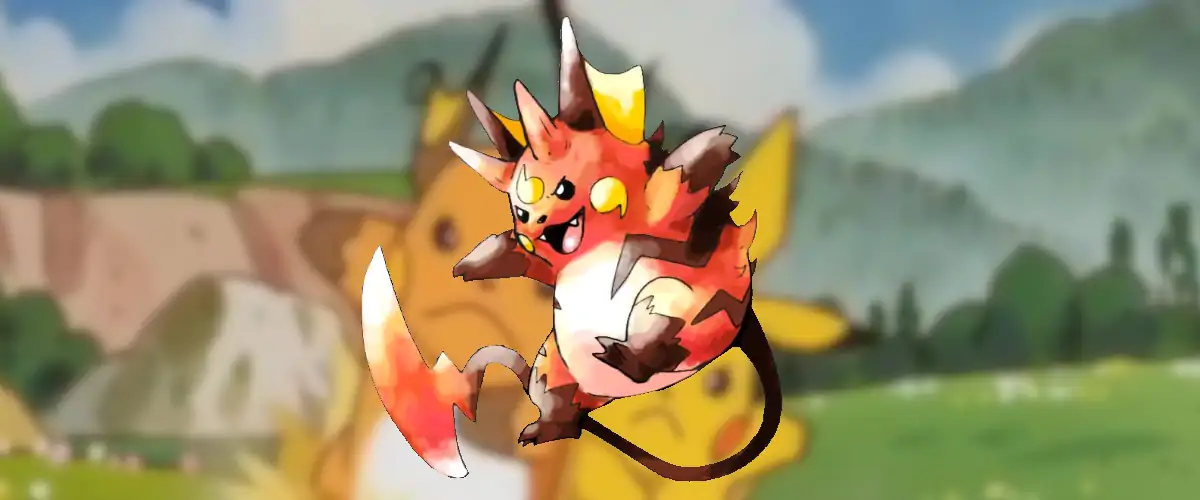
Gorochu is the third evolution of the Pikachu line, cut from Poku00e9mon Red and Blue, which was supposed to follow Raichu and feature fangs and a pair of horns. The most important thing is that Gorochu was only revealed in 2018 during an interview with Ken Sugimori and Atsuko Nishida for Yomiuri, and its existence was confirmed by a 2020 source code leak that contained a backsprite with an index of 175 matching the creators’ descriptions.
What Gorochu looked like – description of the original design
According to Atsuko Nishida, Pikachu’s lead designer, Gorochu had a distinctly more aggressive and mature appearance than previous forms. Key design elements were fangs, suggesting a predatory nature, and a pair of horns growing out of its head, which distinguished it from the round ears of Pikachu and Raichu. The backsprite found in the leaked source code confirms these descriptions, showing a silhouette with distinct horns and a more massive build. The name Gorochu combines the Japanese onomatopoeia goro, meaning thunder, with chu, characteristic of mice, maintaining consistency with previous members of the evolutionary line.
Why Gorochu was not implemented – official reasons
Ken Sugimori explained in an interview that the decision to remove Gorochu was not due to problems with its appearance, but rather to gameplay balance issues. Shigeki Nishino added that there were also limitations on the size of the game data – the Game Boy cartridge memory was extremely limited, and the team had to save space by removing Poku00e9mon originally designed for two evolutions and limiting them to one evolution. Pikachu was not one of the three starters, so its line became an easy target for reduction without affecting the main mechanics of the game.
Trade evolution theory – traces in the game code
In Cinnabar Island Lab, there is an NPC offering to trade Electrode for Raichu – if the player makes the trade, the character says that Raichu has evolved. This dialogue was carried over from the Japanese version, where a different Poku00e9mon with trade evolution was traded, but the text was not updated in the English version. This suggests that Gorochu was supposed to be the fifth trade evolution in the first generation – after Golem, Gengar, Machamp, and Alakazam. The theory is that the odd number of trade evolutions caused problems in the balance of exchanges between players, which may have been an additional reason for Gorochu’s removal.
2020 leak – confirmation of existence
In April 2020, the source code for Pokemon Blue was leaked, containing a backsprite with an index of 175 that matched the descriptions of Gorochu from the 2018 interview. The sprite shows a Poku00e9mon with horns and a larger silhouette than Raichu, which definitively confirms that Gorochu was not just a fan theory or localization error, but an actual, designed Poku00e9mon that was cut in the late stages of production. This discovery changed Gorochu’s status from urban legend to documented scrapped content.
Why Gorochu did not return in later generations
The introduction of Pichu in Generation II as Pikachu’s baby form meant that the evolutionary line reached three stages: Pichu, Pikachu, and Raichu. There has never been a four-stage evolutionary line in Poku00e9mon history, making Gorochu’s return virtually impossible without breaking the established rules of the series. The only solution would be branch evolution, regional variant, or Mega Evolutionu2014but in that case, we would get a new Poku00e9mon inspired by Gorochu, not the original design from the 1990s.
Balance as a reason – analysis of the developer’s decision
The balance argument seems strange from today’s perspective – stats are just numerical values that are easy to change, and Raichu was never particularly powerful in the first generation. What’s more, the Electric type had no two-stage evolution in Gen 1, which made Gorochu unique, not problematic. It is likely that balance refers not to the power of Poku00e9mon, but to the overall structure of the game – the number of trade evolutions, the distribution of types by evolution stage, and cartridge memory limitations that forced cuts in many places.
Impact on fan culture and speculation
The discovery of Gorochu sparked a wave of fan art, theories, and discussions about what the full version of the design would look like. Some fans link it to the Mega Raichu concept, while others speculate about a possible regional form based on the original design. A trending topic on Twitter after its reveal in 2018 shows how strong emotions this lost evolution evokes – a mixture of fascination and relief that the series’ mascot does not transform into an aggressive demon with horns.
What remains of Gorochu – its legacy in the series
Although the Poku00e9mon itself never made it into the games, its concept influenced later designs. Generation VII’s Alolan Raichu introduced an alternate form with a different type and psychic powers, partially filling the niche of Pikachu’s expanded line. Some fan designs for Mega Evolution Raichu clearly reference descriptions of Gorochu with fangs and horns, showing that the idea lives on in fan culture even without official implementation.
Gorochu as a symbol of scrapped content
Gorochu remains one of the most famous examples of a scrapped Poku00e9monu2014it had fangs, horns, and evolved through trading, but was removed due to balance, memory constraints, and design decisions. Its discovery in 2018 and confirmation by a leak in 2020 proved that this was not a fan theory, but an actual design from the early stages of Poku00e9mon Red and Blue. The introduction of Pichu closed the door on a four-stage evolution, ensuring that Gorochu would remain a lost evolution foreveru2014a fascinating glimpse of what the Pikachu line could have been.

 Wodzu
Wodzu