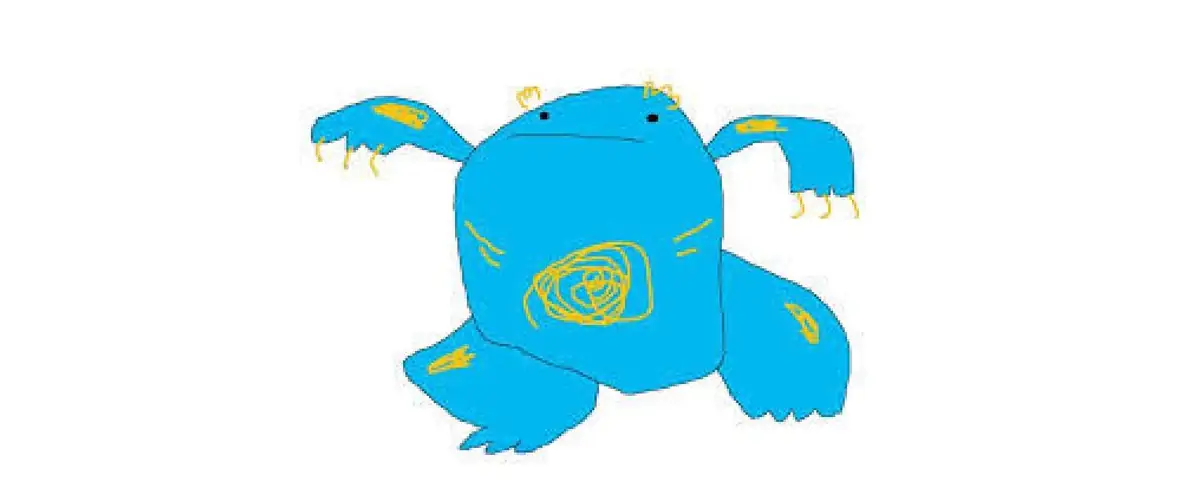
Tentaquil. The Most Popular Fake Pokémon
Tentaquil is a fascinating phenomenon in the world of pocket creature fans – a fictional species that never existed in the official games but gained immense popularity in the online community. This blue, frog-like creature with a yellow spiral pattern on its belly has become one of the most recognizable „fakemon” (fake Pokémon) in history. In this article, we will take a detailed look at Tentaquil’s history, its origins, characteristics, and the impact it has had on fan culture.
The Origin of Tentaquil
The story of Tentaquil began on July 22, 2010, on the /vp/ forum (a section dedicated to Pokémon) on 4chan. During a regular fanart thread, an unusual drawing of a blue, frog-like creature with a yellow spiral pattern on its belly appeared. This image quickly caught the attention of forum users, and within hours, more fan illustrations of this mysterious creature began appearing.
The name „Tentaquil” likely arose from combining the names of existing creatures: Tentacool/Tentacruel and Cyndaquil. Interestingly, despite the similarity in their names, Tentaquil’s appearance bears no resemblance to either species. Its design is more reminiscent of Politoed, though it is distinguished by its blue body and yellow eyebrows.
The Phenomenon’s Growth
Tentaquil’s popularity grew rapidly. Shortly after its initial appearance, enthusiasts even created modifications (ROM hacks) for the games „Pokémon: Fire Red” and „Pokémon: Emerald,” featuring Tentaquil as a starter. These fan projects further strengthened the myth of the creature’s existence.
Particularly interestingly, Tentaquil’s appearance coincided with leaks about new creatures from the fifth generation. This timing was exploited by online pranksters, who began claiming it was one of the new, official species of the upcoming generation. Many inexperienced users fell for this joke, which only increased the popularity of this fictional creature.
Tentaquil Characteristics
According to fan descriptions, it is a Bug/Psychic-type creature with the „Immunity” ability. Its most distinctive feature is a special move called „Puke Blood,” which is supposed to be its signature attack. This rather macabre ability has further contributed to the controversy surrounding the character.
The fan community has created a complete list of moves for him to learn as he levels up:
- Starting Level: Tackle (Attack), Leer (Glance)
- Level 5: Flail (Flutter)
- Level 7: Rock Throw (Rock Throw)
- Level 9: Aerial Ace (Aerial Ace)
- Level 12: Puke Blood (Signature Move)
- Level 15: Surf (Surf)
- Level 19: Sketch (Sketch)
- Level 25: Giga Drain (Giga Drain)
- Level 27: Tackle (Attack)
- Level 30: Scratch (Scratch)
- Level 31: Fury Swipes (Furious Swipes)
- Level Level 34: False Swipe
- Level 39: Earthquake
- Level 46: Fly
- Level 50: Waterfall
- Level 55: Twineedle
- Level 75: Fissure
- Level 99: Splash
This move list is intentionally absurd—it includes attacks that wouldn’t normally be learned by a single species, part of the Tentaquil joke.
Impact on the Online Community
Tentaquil quickly transcended the confines of 4chan and spread to other online platforms. A Facebook fan page and Twitter accounts were created for it, and its image began appearing in various memes, including the popular „haters gonna hate.”
This phenomenon is a prime example of how internet jokes can evolve and take on a life of their own. From a simple drawing on 4chan, Tentaquil became a recognizable element of fan culture, often mentioned alongside other famous fake Pokémon.
Tentaquil in the Context of Other Fake Pokémon
Tentaquil’s story fits into a broader tradition of fake Pokémon and rumors that have accompanied the series since its inception. Even in the first generation of games, legends circulated about mysterious Poké Gods—supposed super-evolutions of existing species, such as Sapsor (the evolution of Venusaur), Charcoalt (the evolution of Charizard), and Raynor (the evolution of Blastoise).
Unlike these early rumors, which spread primarily in schoolyards in the pre-internet era, Tentaquil is a product of the digital age. Its story illustrates how the nature of fan myths has changed with the development of the internet and social media.
- It’s worth noting that it’s not the only famous fake creature. Other well-known examples include:
- N Panda – a supposed evolution of Teddiursa, supposedly available after using the Moon Stone
- Kagi no Mushi – a fake, rejected design from the 1997 Space World demo for Gold and Silver
- Various fake evolutions of Sinnoh starters (fourth generation)
However, it is Tentaquil that stands out for its enduring popularity and recognition, despite being created relatively late compared to other legendary fake creatures.
Why did it become so popular?
Tentaquil’s success as an internet phenomenon can be attributed to several factors:
- Timing – It appeared at a time when fans were eagerly awaiting information about the fifth generation, which created ideal conditions for the spread of fake „leaks.”
- Distinctive design – Despite its simplicity, its appearance is distinctive and memorable enough to facilitate its spread.
- Absurdity – Elements like the „Puke Blood” attack and the moveset impossible to obtain in regular gameplay gave Tentaquil an element of absurd humor that resonated with the online community.
- Community Engagement – Fans quickly embraced the concept and began creating their own interpretations, fan art, and even game mods, significantly contributing to the spread of the myth.
Tentaquil’s Legacy
Although over 13 years have passed since Tentaquil’s first appearance, this fictional creature remains recognizable within the fan community. Its story is often cited as an example of fan creativity and the power of internet myths.
It has also become part of a broader discussion about false leaks and rumors in the video game world. Its case illustrates how difficult it can sometimes be to distinguish between truth and falsehood, especially in an era when official announcements are often preceded by unofficial leaks.
Tentaquil – A Summary of Fakemon Information
Tentaquil is a fascinating example of internet folklore, born from a simple joke on 4chan and then developed into a recognizable element of fan culture. Its story showcases the creativity of the fan community, but also reminds us of the need to critically approach unofficial information circulating online.
While it has never appeared in any official game and likely never will, its place in the history of fan mythos is already assured. This blue, frog-like creature with a yellow spiral pattern on its belly will remain a symbol of fan creativity and the power of internet legends.

 Wodzu
Wodzu