 Wodzu
Wodzu 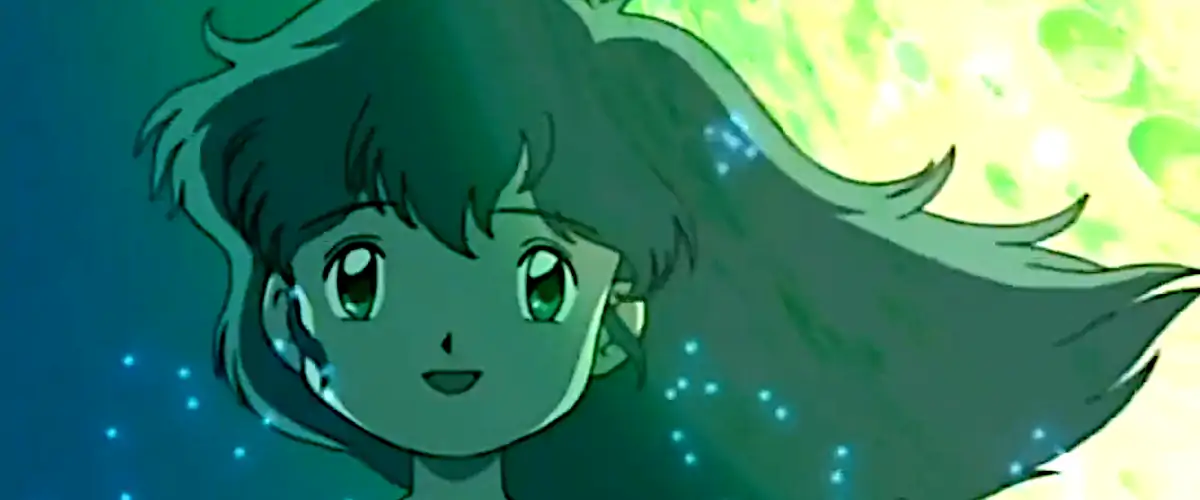
Ambertwo Pokemon – clone of Amber, the daughter of Dr. Fuji in the anime
Ambertwo is an electronic clone of Amber, the beloved daughter of the eminent scientist Dr. Fuji, whose untimely death in childhood led her father to make desperate attempts to bring her back to life through advanced cloning experiments. The character’s story was presented in a Japanese radio drama titled The Birth of Mewtwo and in an extended version of the anime The Uncut Story of Mewtwo’s Origin, which served as an introduction to the feature film Mewtwo Strikes Back, although these scenes were completely removed from the original American theatrical release.
Ambertwo had long turquoise hair, dark blue eyes, and fair skin, and her appearance was a faithful representation of little Amber as she looked when she was still alive.
Unlike the biological cloning used for Mewtwo, she was created by electronically recreating the consciousness of the deceased girl, which means that Dr. Fuji essentially created her personality and memories from his own memory, without the use of traditional genetic material. The tragedy of this character is that, despite the advanced technology and unlimited financial resources provided by the powerful Giovanni, who funded the research in exchange for the creation of the most powerful Pokémon in the world, she could not survive as long as the Mew clone.
The relationship between Amber and Mewtwo in the laboratory
While growing up in special test tubes on New Island, both Mewtwo and the girl communicated telepathically with each other, which created a unique bond between them that went beyond the typical relationship between humans and Pokémon. She was surprised to discover that humans and Pokémon could talk to each other, which led the young Mewtwo to ask a profound philosophical question about whether it was human or Pokémon, a question that later shaped its entire identity and sense of alienation.
The same laboratory also housed other Pokémon clones – Charmander, Squirtle, and Bulbasaur, who, like Amber and Mewtwo, developed their consciousness in the artificial environment of test tubes, forming a small community of beings trying to understand their existence.
She acted as a teacher and guide to the young Mewtwo, showing him memories from her own life, or rather from the life of the original Amber, teaching him about simple things like the sun, rain, the warmth of a family home, and the joy of everyday moments, which were completely foreign and incomprehensible to creatures created in a laboratory. These memories were fundamental to Mewtwo’s emotional development, because it was through sharing them that she taught him what life was like outside the walls of a sterile laboratory, giving him his first glimpse of a world he had never had the opportunity to see with his own eyes.
The tragic end of Ambertwo and her influence on Mewtwo
Unfortunately for Dr. Fuji and Mewtwo himself, the genetic stability of the clones proved to be a critical problem – along with the Pokémon, they began to gradually fade away, their forms becoming increasingly transparent, until they finally disappeared completely, leaving Mewtwo alone, frightened, and distraught. The difference between a Pokémon and a human clone was crucial – Mewtwo’s genetic code as a Pokémon and his immense psychic power allowed him to survive where the girl and the other clones failed, although the English dub also suggested that it was Mewtwo’s tears that helped him stay alive.
Before her disappearance, she comforted the distraught Mewtwo, telling him that life is precious no matter how it was created, and that even if she disappeared, the memories and feelings they shared would remain forever, which was a key lesson about the value of life regardless of its origin.
Dr. Fuji was completely devastated by the loss of his daughter’s clone, but he continued his work on Mewtwo in the hope that another attempt to clone Amber would be more successful, showing how his obsession with bringing his daughter back completely clouded his ability to think rationally and consider ethical considerations. However, any hope of seeing Amber alive again died with Fuji himself when Mewtwo, who had developed full consciousness and felt betrayed by its creators, destroyed the laboratory on New Island, killing all the scientists inside.
The philosophical message of the Ambertwo story
The Ambertwo story touches on extremely profound and difficult ethical issues related to cloning, the value of life, and the boundaries that science should not cross, making this ten-minute anime segment one of the most mature and thoughtful moments in the entire Pokémon series. Through the character of Dr. Fuji, the creators presented the moral gray area of a situation in which a distraught parent is willing to do anything to get their lost daughter back, even if it means working with a dangerous criminal and conducting experiments with potentially disastrous consequences. Ambertwo as a character represents the innocence and purity of a child’s view of the world, and her willingness to share her experiences and accept other creatures regardless of their origin is a moral model that contrasts with the cynicism and exploitation of life as a tool by adult scientists.
Younger viewers can identify with Ambertwo as a child trying to understand the world and make friends, while older viewers, especially parents, see in Dr. Fuji a universal parental fear of losing a child and the desperation that can lead to increasingly questionable moral decisions. The fact that Ambertwo taught Mewtwo that all forms of life are valuable, whether they arose naturally or were created artificially, became the foundation for Mewtwo’s subsequent transformation from a vengeful creature into a being capable of compassion and understanding, showing how a single relationship and lessons from someone who truly cares about us can shape our entire identity forever.
The significance of Amber in the context of Mewtwo Strikes Back
Although the American theatrical version of the film completely removed the Amber scene, its presence in the original Japanese version and subsequent television versions was crucial to fully understanding Mewtwo’s motivations and internal conflicts. Without the context of the loss of Ambertwo and the other clones, Mewtwo’s anger and obsession with proving that the clones are equal to or even better than the originals seem to be simply the result of pride or malice, when in fact they stem from deep trauma and the unjustified loss of his first true friend.
The memory of Ambertwo, though scientists tried to erase it from Mewtwo’s mind, remained somewhere deep in his consciousness as a faint memory of warmth and acceptance, which explains why at a key moment in the film, Mewtwo is able to change his attitude and understand that violence and revenge are not the answer to pain and injustice.
The scene in which Ash turns into a stone statue in an attempt to stop the fight between the originals and the clones directly reflects the lesson Ambertwo taught Mewtwo – that sacrifice and love for other life forms is what gives meaning to existence, regardless of who we are and where we come from. Mewtwo’s decision to take all the clones he created and find a safe place for them to live in peace away from humans is a direct fulfillment of Ambertwo’s dream of a world where all beings can coexist in harmony, making her brief presence in the story extremely meaningful despite her limited screen time.
About the Author