

>
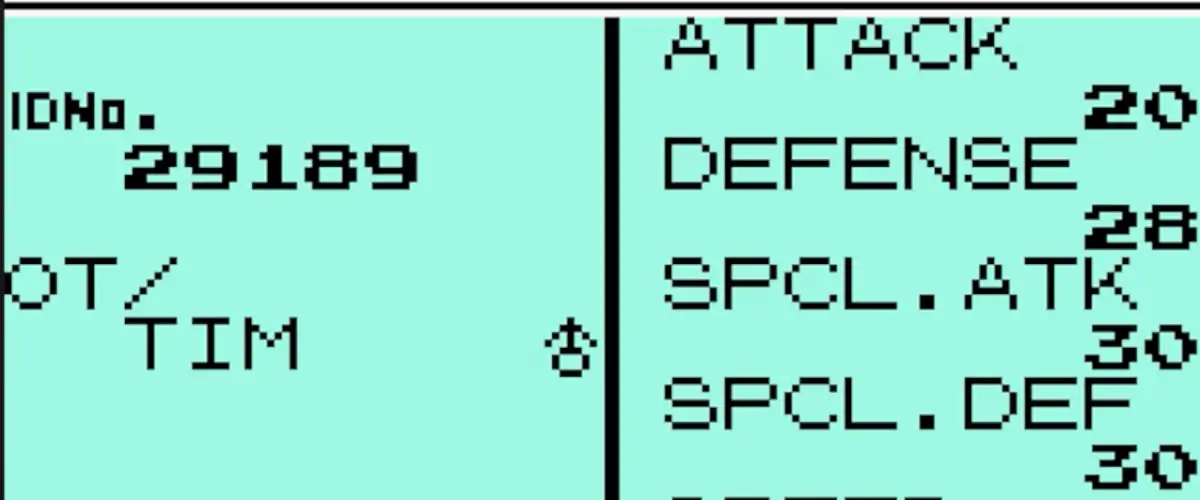
Determined Values (DVs) is a hidden value system that, in the first two generations of Pokémon games, determined the individual stats of each captured Pokémon. This mechanism meant that two seemingly identical Pokémon could have different strength, durability, or speed, even at the same experience level.
Basics of the Value System
The DV system assigns each captured or bred Pokémon a set of five hidden numbers that directly influence its final stats. Unlike modern games, which use Individual Values with a range of 0–31, DVs operate within a much narrower range of 0–15.
Each of these values corresponds to a different stat:
- Attack DV – determines physical strength
- Defense DV – affects defense
- Speed DV – determines speed
- Special DV – controls special attack and special defense
- HP DV – determines health points
- The Mathematics Behind Statistics
The mechanism for calculating HP DV is fundamentally different from other values. It is not independently randomized, but rather results from the combination of the lowest-order bits of the four remaining DVs. The formula is as follows:
HP DV = (Attack DV mod 2) × 8 + (Defense DV mod 2) × 4 + (Speed DV mod 2) × 2 + (Special DV mod 2)
This means that if you know a Pokémon’s four basic DVs, you can precisely calculate its HP DV without additional measurements.
Impact on Final Statistics
The final value of each stat in the first and second generations is calculated using a formula that takes into account:
- Species’ base stat value
- DV value (0–15)
- Stat Experience (equivalent to modern Effort Values)
- Pokémon’s current level
- Example formula for stats other than HP:
- Stat = ((Base + DV) × 2 + √Stat Exp / 4) × Level / 100 + 5
- HP uses a slightly modified formula, adding the level and an additional 10 points.
Shiny Pokémon and its relationship to DV
In the second generation of games (Gold, Silver, Crystal), the Shiny Pokémon mechanic was directly tied to the DV system. For a Pokémon to be shiny, it had to meet very specific requirements:
- Statistic Required DV
- Defense DV exactly 10
- Speed DV exactly 10
- Special DV exactly 10
- Attack DV 2, 3, 6, 7, 10, 11, 14, or 15
This rigid combination meant that the chance of encountering a wild shiny was approximately 1 in 8192. Furthermore, due to the Attack DV limitation, shiny Pokémon typically had lower physical attack stats than they otherwise could have.
Gender and DV Values
The second generation also introduced a Pokémon gender mechanic, which was deterministically tied to Attack DV. Each species had a specific threshold – Pokémon with an Attack DV below this threshold were female, and above it, male.
For example, for starters with a gender ratio of 87.5% male to 12.5% female:
- Attack DV 0–1: female
- Attack DV 2–15: male
This mechanic led to interesting limitations: some shiny + female combinations were extremely rare or even impossible, as the required Attack DV for shinys often exceeded the threshold for females.
Inheritance in Breeding
The second-generation breeding system allowed for partial DV transfer to offspring. The mechanism worked as follows:
- Defense DV was always inherited from the parent (or breeding partner).
- Special DV had a 50% chance of being inherited or shifted by ±8.
- Attack DV and Speed DV were usually randomized, unless the parent was shiny.
This allowed players to increase their chances of obtaining shiny offspring if one of the parents was already shiny – the probability increased from 1/8192 to approximately 1/64.
How to Calculate a Pokémon’s DV
There are several methods for checking the DV value without using external tools. The most basic approach requires:
Step 1: Record the Pokémon’s exact stats at a specific level
Step 2: Reset Stat Experience to zero (optional, to simplify calculations)
Step 3: Use the inverse of the stat formulas, substituting known values
Step 4: For each stat, solve the equation for DV in the range 0–15
Step 5: Verify HP DV using the bit formula
In practice, players often used community DV calculators, where they simply entered the level, species, and current stats, and the tool automatically calculated possible DV values.
- Differences between DV and IV
- DV Trait (Gen I–II) IV (Gen III+)
- Value Range 0–15 (4 bits) 0–31 (5 bits)
- HP Calculated from other DVs Independently randomized
- Relationship to Shiny Direct Independent
- Relationship to Gender Yes (Attack DV) No
- Combination Precision 16 possibilities 32 possibilities
The switch to the IV system in the third generation marked the end of the DV mechanic and the introduction of a much more flexible system.
Development History
1996 – Pokémon Red/Green (Japan): First implementation of DV as a simple way to differentiate Pokémon. The system was hidden from players but quickly discovered by the community exploring the game’s code.
1999 – Pokémon Gold/Silver: Introduction of a DV connection to gender and the Shiny mechanic. This gave DVs new strategic importance.
2002 – Pokémon Ruby/Sapphire: The definitive end of the DV system. The third generation replaced it with Individual Values, which range from 0–31, completely separating shiny from stat values.
Impact on Modern Gameplay
- Although DVs are no longer used in modern Pokémon games, their legacy remains:
- System IV is a direct descendant of the DV mechanic.
- The concept of hidden genetic values has become a cornerstone of competitive gameplay.
- The speedrunning community continues to analyze DVs in classic titles.
- Collectors seek out Gen II shinys for their unique origins.
Advanced DV Manipulation Techniques
Experienced second-generation players have developed methods for deliberately obtaining high DVs:
- Reset Technique: Saving the game before obtaining a permanent Pokémon (e.g., starter Pokémon, Eevee), checking stats after receiving them, and resetting until satisfactory values are achieved.
- Breeding Shinies for DVs: Taking advantage of the fact that a shiny parent increases the chances of producing shiny offspring while also passing on some of the beneficial DVs.
- Ditto Usage: In the second generation, Ditto could breed with any Pokémon, allowing for the ability to combine different DV lines without species restrictions.