


Strangled Red is one of the most recognizable and moving horror stories related to the world of pocket-sized creatures, known as Creepypastas. This dark tale, which has gained immense popularity among the internet urban legend community, tells the tragic story of a trainer named Steven and his beloved fire lizard, Mickey. Unlike many similar stories, Strangled Red stands out for its emotional depth and psychological approach to themes of loss, obsession, and madness.
Spis treści
History and Context
Strangled Red was originally published in 2012 by user ShadowMaleRenamon. It quickly gained popularity among fans, becoming one of the most acclaimed stories in its genre. This story stands out from other similar narratives because, instead of focusing solely on supernatural elements or terrifying glitches, it focuses on the protagonist’s emotional journey and his gradual descent into madness after the loss of his beloved companion.
This story is often cited as one of the best in its genre, though it is not without its flaws and plot inconsistencies. Its strength lies primarily in its portrayal of the psychological aspects of grief and obsession, making it more mature than many similar stories.
Strangled Red Plot
The story begins with the narrator finding a mysterious cartridge in a neighbor’s trash can. The cartridge depicts Charmander on the label, but is strangely marked „Strangled Red Version.” After asking the neighbors about the game, they claim they’ve never seen it, although their young child recognizes the character on the cartridge and asks his mother to buy it for him. The mother refuses, claiming the child doesn’t even have a proper gaming console.
Intrigued, the narrator takes the cartridge home and starts the game. The start screen shows Charizard with a strange wound on his neck, resembling a tear. After several unsuccessful attempts to continue the saved game (the system responds with „No…”), the narrator begins a new game.
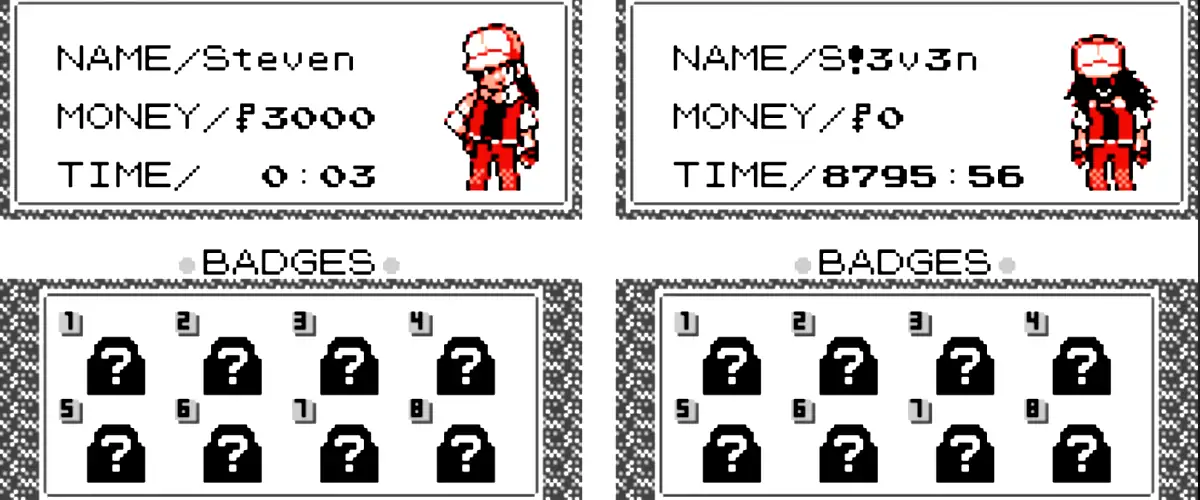
Instead of a standard protagonist, the player controls a character named Steven, who looks similar to Red from the original games, but with longer hair and a confident smile. Steven already has a starter Charmander named Miki, who proves exceptionally strong. Miki quickly defeats the first leaders and evolves into Charizard at level 25.
The first anomaly appears in Lavender Town, where Steven refuses to enter Pokémon Tower, saying, „I have no reason to be there.” This is unusual, as there are many places in the game where entering is not necessary, but this is the only one where the character explicitly refuses.
The game continues as normal, with Steven defeating the remaining leaders and reaching the Pokémon League, where he meets his brother, Mike, the champion. After defeating him, the brothers congratulate each other, without the typical rivalry seen in the original games.
After the game ends, the action shifts to the brothers’ house, where Mike asks Steven to borrow Miki to complete his Pokédex. Steven reluctantly agrees, but something goes wrong during the exchange process. Miki disappears, and the message „Connection Error” appears on the screen. Mike is devastated and apologizes to his brother, but the damage is irreversible – Miki is gone forever.
From this point on, the game changes drastically. The action shifts to a year later, and Steven finds himself in Pokémon Tower in front of a grave. The music changes to the signature theme from Lavender Town, which will accompany the player for the rest of the game. Steven no longer has any creatures, items, badges, or money. He is an empty shell of a man who has lost everything he loved.
The player can now freely explore Kanto, but all NPCs treat Steven with pity or avoid him. Some offer him drinks or food, but Steven always refuses. His sprite moves slower than normal, further emphasizing his mental state.
After visiting Pallet Town and speaking with Professor Oak („These things happen… you just got unlucky”), Blue’s sister („Please… don’t leave the house again”), and discovering that Red’s mother refuses to talk at all, the player finds Steven and Mike’s house west of the town.
In the house, Mike only says, „I’m so sorry,” suggesting he feels guilty for what happened. When the player puts Steven to bed, the screen darkens, and when it brightens, it’s already night. Mike sleeps in the next bed, and Steven says, „I’ll do this… THIS can bring her back… THIS can do anything…”
Steven leaves the house and heads west of Pallet Town, where it’s normally inaccessible. His sprite begins to swim in the water, which is impossible in the standard game. He reaches Cinnabar Island, where he encounters the legendary glitch, Missingno. Instead of fighting, Steven simply says „MINE,” and Missingno is caught without using a Poké Ball.
Missingno, however, doesn’t appear as a party member, but as an inventory item. Steven returns to Lavender Town, where the townspeople either ignore him or say disturbing things like „Just go” and „Sometimes it’s better to stay dead.”
In Pokémon Tower, Steven uses Missingno on a grave, causing a Charizard named „MIKI” with a status of „DED” to appear. Her sprite is distorted, and her only known move is „PAIN.”
Steven returns to Pallet Town, where Mike is horrified by the sight of Miki. He tries to convince his brother that what he did was wrong, but Steven replies, „In a world that cheated me, why should I play fair?”
The screen fades to black, and when it brightens, Mike and his mother lie dead on the floor. Steven stands over them, his sprite drastically changed – he now has a black face with a white grin from ear to ear and red, glowing eyes. This character is known to fans as „S!3v3n.”
The player attempts to save the game, but the message „Nothing can be saved anymore” appears. After exiting the game and restarting, the start screen shows a distorted Charizard and a maniacal S!3v3n instead of a normal Trainer.
Analysis and Interpretation
Strangled Red stands out from other similar stories for its psychological and emotional depth. Steven’s story is one of grief, obsession, and a refusal to accept loss. His gradual transformation from a confident, successful Trainer to a crazed killer is presented in a subtle and disturbing way.
The symbolism in the story is rich and multi-layered. Miki, as Steven’s first and most beloved companion, represents his innocence and joy of adventure. Her loss is the catalyst for his downfall. Lavender Town, the burial site of the creatures, becomes the focal point of the narrative, emphasizing themes of death and mourning.
Missingno, a Pokémon glitch from the original games, is presented here as a force capable of disrupting the natural order of things—exactly what Steven desires. His determination to bring Miki back to life leads him to manipulate the very structure of the game, reflecting his refusal to accept reality.
Steven’s final transformation in S!3v3n symbolizes his complete loss of humanity and descent into madness. His new appearance, with a black face and a maniacal grin, is a visual representation of the inner darkness that has consumed him.
It’s worth noting that this story can be interpreted as a meta-commentary on players’ attachment to their digital companions. For many fans of the series, their virtual companions hold immense emotional significance, and Steven’s story demonstrates how far this bond can go when it transcends the boundaries of common sense.
Impact on the fandom
Strangled Red has had a significant impact on the internet urban legend community. The story has inspired numerous fan art pieces, video adaptations, and even been incorporated into the Friday Night Funkin’ mod called „VS Pokepasta Perdition.”
The character S!3v3n has become a recognizable part of internet culture, frequently appearing in compilations and discussions of the best video game horror stories.
Despite some plot inconsistencies (such as Mike completing his Pokédex without possessing all his evolutionary forms), Strangled Red is often cited as one of the better stories in its genre. Its strength lies in its emotional depth and psychological realism, which distinguish it from more superficial tales.
Criticism and Controversy
Like any popular internet story, Strangled Red is not without criticism. Some reviewers have pointed out plot inconsistencies, such as Mike’s difficulty completing his Pokédex or the ambiguous ending. Others criticize the concept as being too similar to other stories using the Lavender Town motif.
Some fans also feel that the story relies too heavily on familiarity with other similar stories, which can make it difficult for those unfamiliar with the genre. The narrator’s self-consciousness, who mentions that „Lavender Town is the subject of every scary story,” can also reduce immersion.
Despite these criticisms, Strangled Red remains one of the most acclaimed and discussed stories in its genre, precisely because of the emotional depth and psychological realism that distinguish it from other similar tales.
Summary
Strangled Red is a moving story of love, loss, and obsession that transcends the typical conventions of its genre. The story of Steven and his beloved Mika explores universal themes of grief and the refusal to accept loss, dressing them in familiar elements of the video game world.
Despite some plot flaws, the story’s strength lies in its emotional depth and psychological realism. Strangled Red doesn’t just scare us with jumpscares or macabre imagery, but through its unsettling portrayal of a man who loses everything he loves and gradually descends into madness.
This story remains a staple of internet culture, inspiring generations of creators and fans. Its legacy endures, reminding us of the power of storytelling and the emotional impact even the simplest video games can have on us.